 Sock Wholesalers
How to vet a socks supplier before money moves
Vetting a socks supplier comes down to five checks you can run before any payment: the business register, the shipping record, the certificates, a physical sample, and the paperwork that makes a quote binding.
Minimum per style on bulk orders. Confirmed for your construction on the quotation.
Sample lead time after you confirm the brief and artwork, not after the first email.
Bulk lead time after deposit received and sample approved.
BSCI and SEDEX (SMETA), held by the factory entity and published with numbers.
Five checks, in the order to run them
Each check stands on its own; together they answer the only question that matters before a deposit: is this supplier what it says it is?
Run the same five on us — every check below links the page where we publish our own answer. The companion guide is OEM vs ODM socks, and both guides live in the guides hub.
There is no PDF of this list to download: the five lines are short enough to copy onto one sheet, and this page is the version that stays current.
- Register: the entity name, number and address resolve at the national business register.
- Shipping: customs records show real shipments in your product category.
- Certificates: audit reports carry number, holder and dates, verifiable at the issuing body.
- Sample: you approve a physical sample and bulk runs to it.
- Paperwork: price, term, MOQ and lead time bind on the proforma invoice, against your confirmed spec.
What can you check before contacting a supplier?
Two public records exist whether or not the supplier ever replies: the company's business-registration entry and its customs shipping history. Both are checkable without the supplier's cooperation, which is what makes them the honest first filter.
If the name on the email signature does not match any registered entity, stop there. One detail worth knowing early: a sourcing setup can involve two registrations, a factory and an export or contracting company, so ask which entity would hold your contract and look that one up.
Then look at the shipping record. Customs-data services such as ImportYeti list export shipments by company name, so you can see whether the supplier actually ships the product category it claims, to which markets, and at what rough volume.
A factory that knits socks shows sock shipments; a reseller shows someone else's containers or none at all.
We publish both routes for ourselves, step by step, on the verify-us page: our register entry and our shipping record, with nothing held back pending a phone call.
How much does this cost? Nothing but time: registry lookups and customs searches are free at the basic tier, and the certificate databases resolve for anyone.
A supplier who resents being checked is telling you something; the ones who publish their own routes, as we do, have already done half your work.
Which documents should a factory be able to show?
Audit certificates, printed with their number, holder and dates as text. A certificate only means something if the holder named on it is the entity that would hold your contract, so the three fields travel together or the claim is not checkable.
For a socks factory, the two files worth asking for are a BSCI audit report and a SEDEX (SMETA) audit report. Ask for the numbers, then verify them with the issuing body rather than accepting a logo.
A logo can be copied; a number plus holder plus dates either resolves at the issuing body's database or it does not.
Read the report itself, not just the summary page. A SMETA audit reports on labor standards and health and safety, and in its fuller version on environment and business ethics, at the audited site — and it lists corrective actions still open.
How a supplier talks about closing those actions tells you more than any badge. Neither file replaces the other: BSCI is the audit framework, SEDEX is the platform the data sits on, and buyers ask for both by name.
Ours are published the way we ask you to demand from any supplier: BSCI 26-0419962, valid until 14 Aug 2027, and SEDEX (SMETA) ZAA600215648, audited 12–13 Aug 2026, both held by Zhuji Qingsheng Knitting Co.,Ltd. — the factory entity, not the export desk.
The full table with dates exactly as printed on the documents sits on the certificate page, and we send the PDFs on request.
Why does a physical sample come before any bulk order?
Because the sample converts every written claim into a physical object you can test, wear, wash and take apart. Bulk that runs to an approved sample gives you a reference object; bulk that runs to a description gives you an argument.
The workable rule: nothing goes to bulk until you have approved a physical sample, and the production run is contractually tied to that sample.
Ask how the supplier handles the approved unit. We keep a signed copy on file against your order number, and bulk runs to it — so a dispute has a reference both sides have touched.
Expect sampling to cost something and ask what the fee covers. On our floor, sampling is charged per style; the sampling fee is credited against the bulk order; we quote the fee with the quotation, and you cover courier freight.
Sampling typically takes 3–5 days after you confirm your brief and artwork; the process page sets out each stage and who holds it.
A sample request moves fastest when it arrives complete: the construction, the size range, the colors and the artwork or a physical reference. Note whatever a supplier asks you to add — a long list of questions before sampling is a supplier doing its job, not stalling.
Keep the approved sample numbered and signed by both sides. If a dispute ever reaches a third party, that signed reference is the thing they will ask for first. What gets checked against it, line by line, is the Sock Quality Control Checklist.
When does a price become binding?
Only at the proforma invoice, issued against your confirmed specification. Anything on a website, in a catalog or in a first email is an invitation to enquire; the binding price, trade term, MOQ and lead time are the ones printed on the PI.
This is not a dodge — it is how the numbers stay honest. A price quoted before the spec is final is a guess, and a guess that later moves is what sours sourcing projects.
The workable standard: the supplier quotes against your confirmed spec, color count and quantity, and the PI carries the binding figures.
That is also how we write this site: pages describe what the floor makes and the terms you ask about, and state plainly that the binding numbers arrive on the proforma invoice. The full wording sits in the terms of use.
One payment rule belongs in every vetting file: send money only to the account named on the PI, and if account details change by email, stop and call back on the number you already hold. Account-change emails are a known fraud pattern, and the call-back costs one minute.
What a PI should carry, at minimum: both legal names as registered, the specification you confirmed, the price and currency, the trade term, the payment split, the lead time from deposit, and a validity date. If a supplier resists putting any of those in writing, that resistance is the finding.
What if you cannot visit the factory?
Use a live video walkthrough, and keep the strongest tool for last: a third-party inspection. A video call you schedule is a filter; an unannounced one is a stronger filter; an inspector you hire is the strongest of the three.
Ask the supplier to walk the floor on a video call while you direct the route, and record the call.
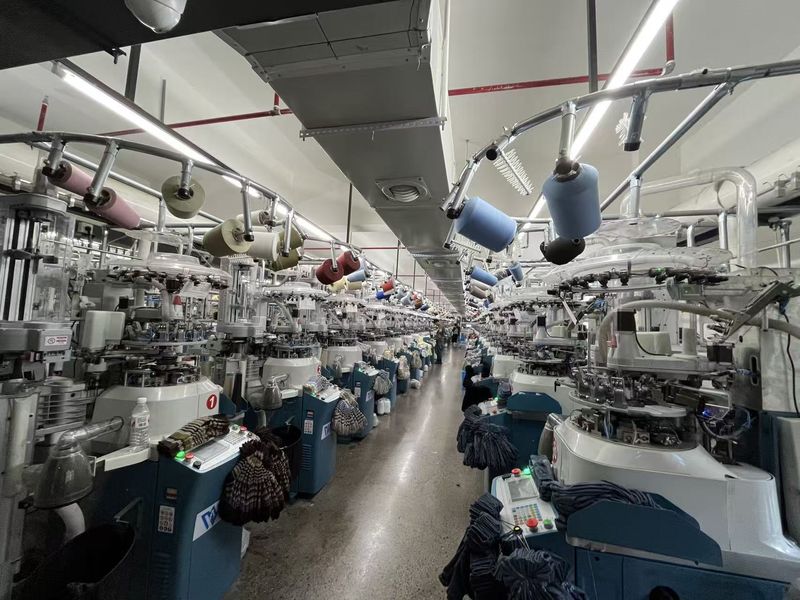
Ours run live and unedited: you pick what to see — the machines and the needle count you are being quoted on, the yarn for your construction, the sample next to a bulk unit, the packing table — and you can book the unannounced version, where the floor does not know the call is coming.
If something you asked for is not there, you will see that too. Two questions make any walkthrough sharper: show me the machine that would run my order, and show me the last order that shipped. Both are ordinary requests on a working floor; how they are answered on camera is data.
A third-party inspection remains the strongest single check before shipment, and a supplier confident in its floor will not resist one. None of these three replaces the sample; they stack.
Send the spec you already have. We cost it against that.
When the checks come back clean, the next step costs nothing: send the brief and get a costing back within one working day.