 Sock Wholesalers
Sock case study: one buyer, one custom design, and every stage of it on the record
This page carries one case, not three. It is the only program we can put on the record with a buyer’s own words behind it, and a page with one case that holds up is worth more to a buyer than a page with three that do not. When a second buyer agrees to appear here, the page gains a second case; until then it stays at one.
What follows is the case as the record has it: what the buyer asked for, the windows the work ran on, the four artefacts anyone can ask to see, and — in its own section — what this page will not publish and why. Every block names the page on this site it comes from, so nothing here has to be taken on trust.
- Buyer
- United States
- Route
- Custom design
- Sampling
- 3–5 days
- Bulk
- 20–30 days
Filing rule for this page: the buyer is named by market and by route, never by company. The case is filed from a buyer review recorded on the about the factory page, adapted from the Alibaba.com store of an affiliated company with identifying details removed — that is the source, and it is quoted verbatim further down rather than paraphrased into something stronger.
The clock this program ran on
Before the case itself, the spine it shares with every other program on this floor. These four windows are the ones this site quotes everywhere, and the case below does not move any of them: it could not, because they are set by the machines and the paperwork rather than by the buyer.
Day 0
Brief and reference
What the sock is for, the market it sells in, the quantity band, and the artwork or a physical reference. For this buyer the reference was a custom design rather than a stock shape.
3–5 days
Sample knitted
Knitted on the needle count the brief settles, with the artwork keyed to the stitch grid. The clock starts when the brief and the artwork are confirmed, not at first contact.
On approval
Signed and filed
The approved sample is a physical one, and a signed copy stays on file against the order number. The sampling fee is credited against the bulk invoice at the same step.
20–30 days
Bulk knitted and checked
Counted from deposit received and sample approved. Inline checks run through the bulk, then the cartons are checked against the signed sample before they close.
Then transit
Collected and shipped
Sea is roughly 25–40 days, air 5–10, express 3–7, set by the mode. The desk books the load and sends the tracking once it moves.
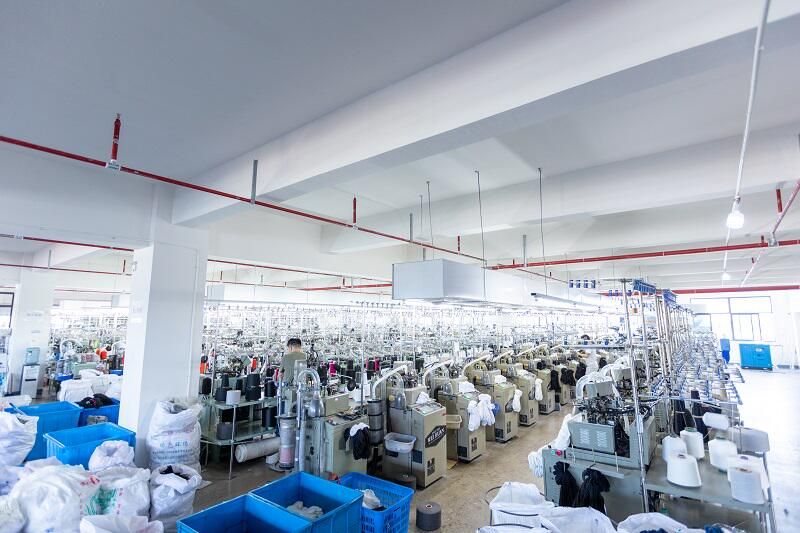
Our own knitting floor in Zhuji, photographed where an order runs rather than in a studio. The stops an inspector would walk — gate, workshop, knitting, boarding, yarn store, warehouse, showroom — are photographed one by one on the about the factory page.
A buyer who brought a design and asked for it back exactly
A buyer in the United States, working on a custom design rather than a stock shape. That is as specific as the published record goes, and it is enough to lay the case out: a design arrives, the floor answers whether its machines hold that construction, a physical sample settles it, and bulk runs against the sample that was signed.
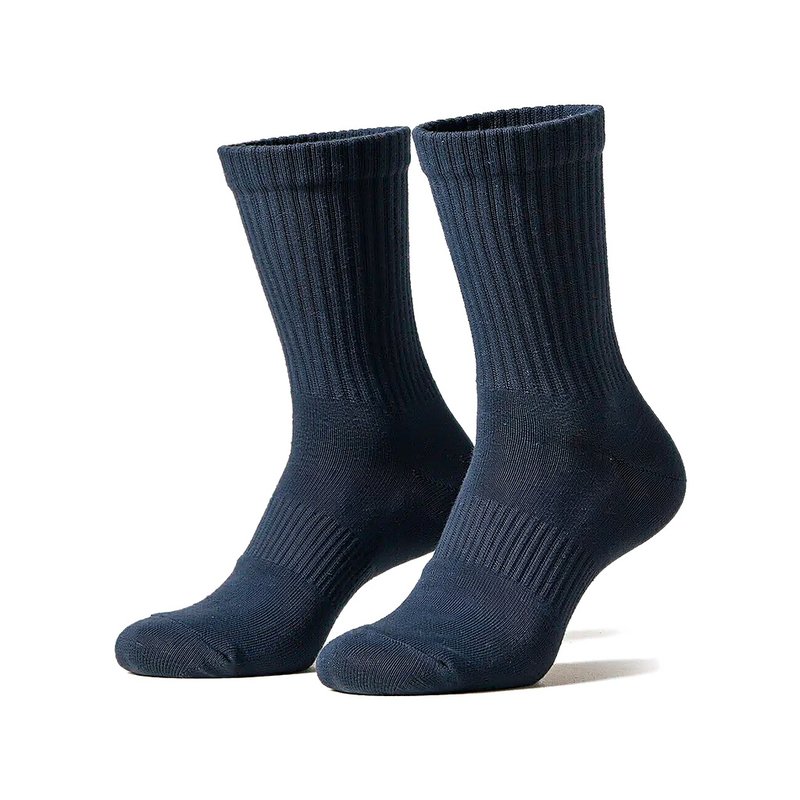
The construction is what a custom brief is judged on: needle count, cushioning zones, colour count, cuff behaviour. The photograph is from our own style library, taken on this floor.
The hard part of a custom design is not the knitting. It is the handover: whether the construction the buyer has in mind is one the machines hold, and whether the sample that comes back is the one that will be signed. So the reference is treated as the specification — needle count, terry density where the sole is cushioned, colour count, cuff elasticity — and the answer on whether the floor holds it comes back before sampling starts rather than after it.
The route itself is not recorded in the source, and this page does not guess at it. A custom design can be the buyer’s own specification (OEM) or a base that already runs, adapted for their market (ODM); the two differ in who owns the design and what the buyer has to supply, and the difference is worth settling in writing before a sample is knitted. OEM vs ODM socks lays the two side by side.
“Worked with them on a custom design. Easy to talk to and replies came quickly. Quality was good, delivery was fast, no complaints from us. Would recommend them.”
Verbatim from the buyer review quoted on about the factory: “Buyer in the United States. Adapted from a buyer review on the Alibaba.com store of an affiliated company; identifying details removed.” Not edited for this page, and not extended — the review is the whole of what the buyer put on the record.
What sits behind the case: an approved physical sample on file against the order number; the dye-lot record that ties the cones to that order; BSCI 26-0419962, valid to 14 Aug 2027, and SEDEX (SMETA) ZAA600215648, audited 12–13 Aug 2026, holder: the factory entity; and a floor that knits, links, boards, inspects and packs in one building in Datang, Zhuji. Ask for any of the four on a call and it is shown rather than described. Start a custom brief →
- Brief
- A custom design, from a buyer in the United States. The source records the working relationship rather than the commercial detail: no pair count, no quantity band and no unit price appear in it.
- Reference
- Where a buyer holds a physical reference sock it answers most of the questions a written specification would. Colors are matched on yarn from a physical reference rather than from a screen.
- Sample
- Typically 3–5 days once the brief and artwork are confirmed, charged per style, credited against the first bulk order. The courier for the sample is on the buyer’s account.
- Approval
- A physical sample is signed, and the signed copy stays on file against the order number. That file is the binding reference the bulk run is checked against.
- Bulk
- Typically 20–30 days from deposit received and sample approved, then the mode the buyer chose for transit. “Delivery was fast” is the buyer’s own phrase, and the only record of that leg on this page.
What this page will not put on the record
A case study earns its place by what it refuses to invent. Five things sit behind this case that are not published here, and each has a reason that a buyer can check against the source pages.
Not published
The pair count
The source records a working relationship, not an order size. A number printed here would be a number about somebody else’s order dressed as this one’s.
Not published
The unit price
No price ladder is published anywhere on this site; the price that matters is costed for your own quantity, artwork and specification.
Not published
The buyer’s identity
Market and route only. Identifying details were removed before the review was published, and this page does not add them back.
Not published
A defect percentage
A claimed pass rate with no inspector behind it is the easiest number to print and the hardest to defend. The inspection route is published instead: book your own.
Not published
The exact dates
Every day marker here is a window off the published terms, because those are the windows the floor commits to and the proforma invoice carries the binding date.
What is left is not thin: a signed sample, a dye-lot record, two audit numbers with a named holder, eight photographed stops on the floor your order would run on, and a live video call where you choose what the camera points at. Those are the things a buyer can hold. They are also the reason one case is enough to read — the case is the doorway; the floor is the evidence.
Where a custom-design brief usually lands
Three constructions on this floor that a custom brief arrives on most often. None of them is claimed as the case above — the source does not name a style — and each card opens the style’s own page, with its photographs, specification sheet and sample terms.
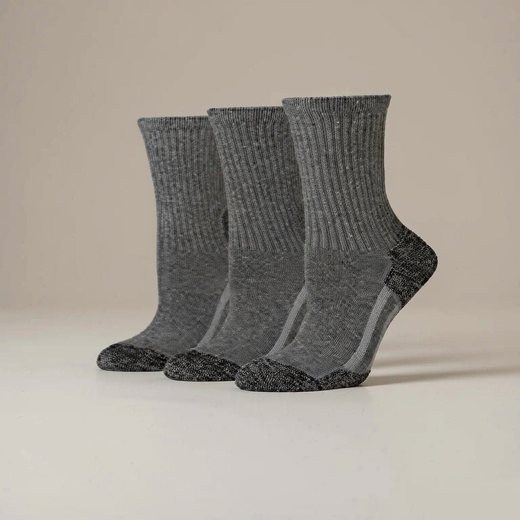
Cushioned athletic crew
The spandex, polyester and cotton crew with a cushioned sole: the shape a sports custom brief usually starts from.
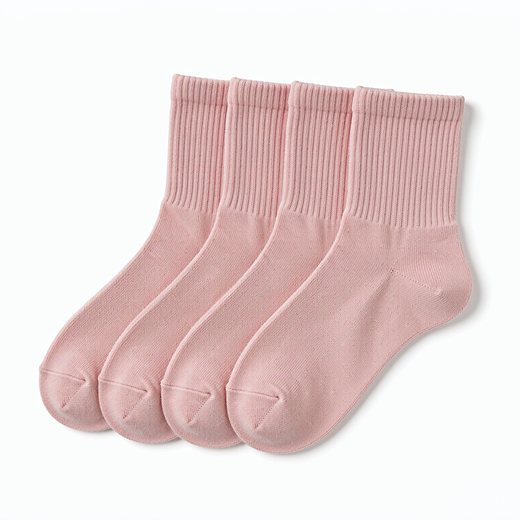
100% cotton crew
Combed cotton, listed as 100% cotton: the construction where knitted lettering and a dry hand are the point of the brief.
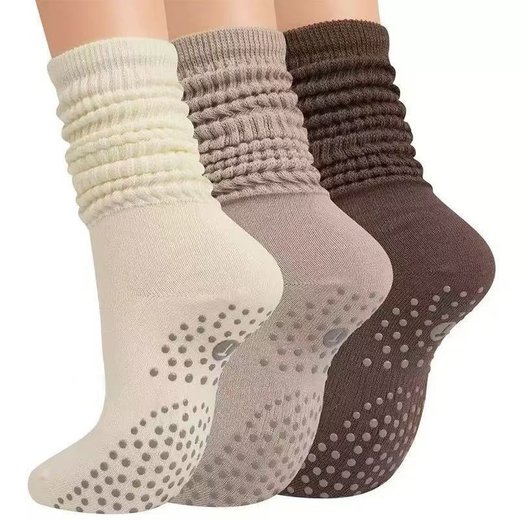
Grip-sole studio crew
Nylon and cotton with a silicone dot layout on the sole: the brief where the grip layout is settled before sampling starts.
More constructions sit on the products page, and the fibre behind any of them is on sock materials. The terms these programs run on are on wholesale terms.
Where every block on this page comes from
Seven sources, each one a page you can open in another tab. If a sentence above cannot be traced to one of these rows, it should not be on the page.
- about the factory
- The buyer review quoted verbatim in the case, with the line that describes how it was adapted and anonymised.
- about the factory
- The eight floor stops — gate, site, workshop, production floor, boarding, yarn store, warehouse, showroom — and the artefacts a buyer can ask to see.
- about the factory
- Annual capacity of 20,000,000 pieces across 4 production lines, with 51–100 people on the floor and the export desk.
- about the factory
- BSCI 26-0419962, valid until 14 Aug 2027, and SEDEX (SMETA) ZAA600215648, audited 12–13 Aug 2026, holder Zhuji Qingsheng Knitting Co.,Ltd.
- wholesale terms
- 1,000 pairs per style, sampling 3–5 days, bulk 20–30 days, the 30-day claims window, the transit windows and the Incoterms list.
- sample policy
- The fee charged per style, credited against the first bulk order, with the courier on the buyer, and the signed sample kept on file.
- OEM vs ODM socks
- The vocabulary used for the route: who owns the design, what the buyer supplies, and why the difference is agreed in writing.
Two pages describe merino differently today — the yarn guide records that no current style runs in it, the ski sock page lists merino wool on its specification — and this page does not build on either claim. It is noted here rather than smoothed over, in the same spirit as the section above.
Tell us what your custom design has to do
A photo of a sock you already sell, a drawing, or a written specification are all a starting point. What helps most in the first reply is the end use, the market, and the quantity band you can carry.
If the construction you need sits outside what this floor holds, the answer says so before a sample is charged, rather than after one has been knitted.
We use what you send only to answer this enquiry and quote against it (legal basis: steps toward a contract, GDPR Art. 6(1)(b)). Enquiry data is kept for up to one year, then deleted. Enquiries are received and handled in China.
You can ask to see, correct or delete your data at any time by writing to sales@sockwholesalers.com; we answer rights requests within one month. Full notice: Privacy notice.
If this form does not go through, email sales@sockwholesalers.com and Michelle Zhang, Export sales manager, will answer you.
Before you write
Every day marker on this page sits inside the windows printed on wholesale terms. Where a page on this site states one of those windows, wholesale terms is the page it is stated from; where a date binds an order, the proforma invoice is the document that carries it.
A short brief is enough to start: end use, market, quantity band, and whatever you already have — artwork, a specification, or a sock you can photograph. The reply comes back within one working day with a costing on your own specification, and a written answer on whether the construction is one this floor holds.