 Sock Wholesalers
Diabetic socks vs compression socks: two different jobs
One word names a wearer. The other names a pressure band. A diabetic sock is bought for a cuff that does not bind; a compression sock is bought for graduated pressure on a lower leg. Putting them on the same shelf under one grade is the mistake this page exists to stop.
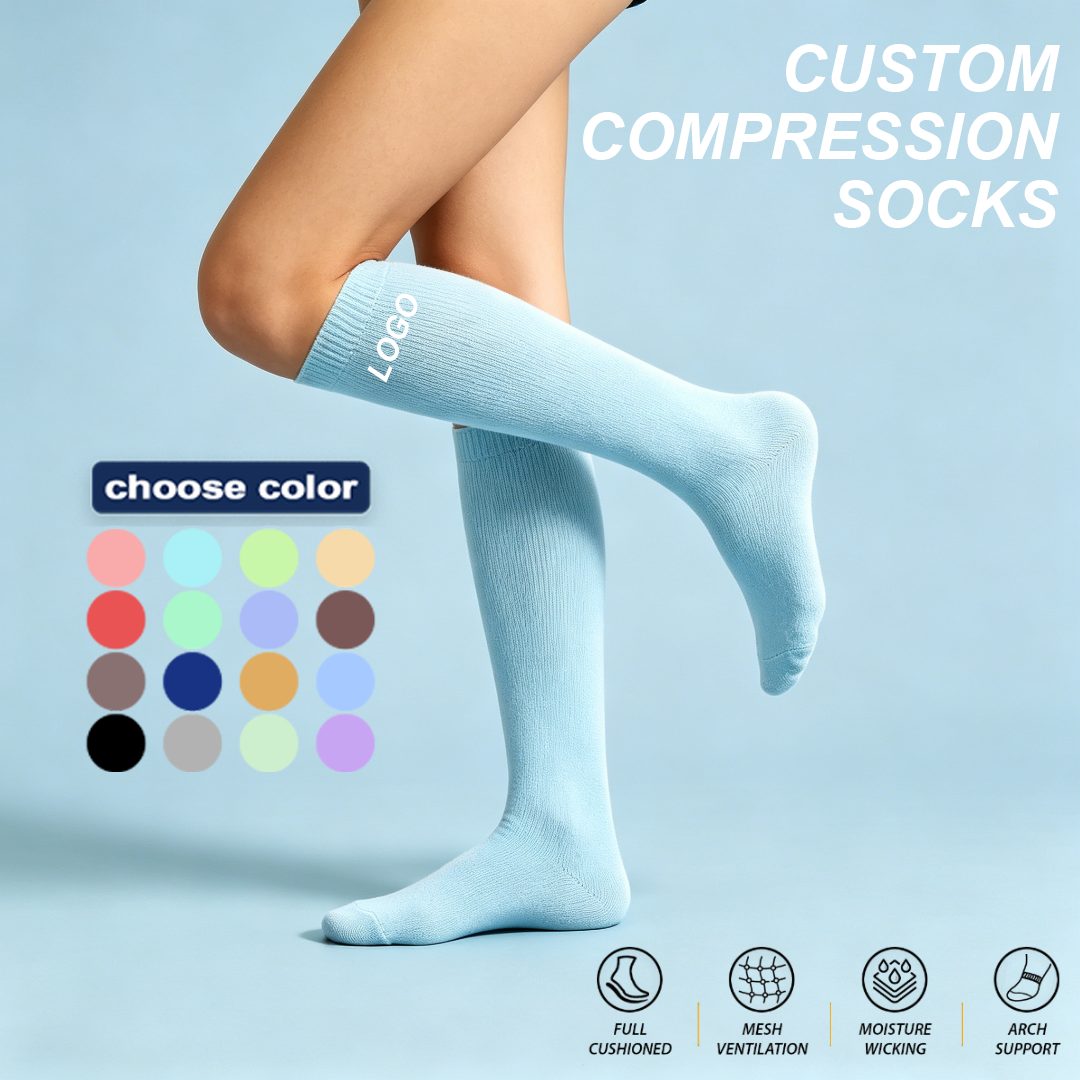
The pressure band we publish, on our knee-length compression style.
No RAL-GZ 387/1 class claimed, and no medical-device registration held.
Crew, knee and over-the-knee constructions on the floor.
Minimum per style. The count is pairs per style, not per size.
1. One names a wearer, the other names a pressure
"Diabetic sock" describes who the sock is sold to. "Compression sock" describes what the sock does to the leg. Those are different kinds of word, which is why they cannot be ranked against each other — a sock is not a better diabetic sock for being a compression sock, or the other way round.
In the trade the two are defined by opposite properties. A diabetic sock is built to avoid pressure: a non-binding top, a seam that does not rub, a yarn that manages moisture, and padding where a foot is at risk. A compression sock is built to apply pressure, graduated from the ankle upwards to a stated band. One is trying not to squeeze; the other exists in order to squeeze.
That is the whole distinction, and it is enough to explain why the two are not interchangeable, why one does not upgrade to the other, and why a buyer who asks for "diabetic compression socks" is usually holding one requirement and describing another.
Basis: the description of diabetic socks as non-binding, seam-free and moisture-managing published by health and sock-trade sources (see the source list), set against the compression-sock entry in our own glossary, which defines the product as applying graduated pressure to a lower leg to a pressure specification the buyer supplies.
2. Line by line
| Line | Diabetic sock | Compression sock |
|---|---|---|
| The job | Protect a foot that is slow to feel injury or slow to heal. | Apply graduated pressure to the lower leg. |
| Cuff | Non-binding top, knitted with minimal elastic so it holds without marking the leg. | A ribbed cuff that grips, because the whole garment is under tension and has to stay placed. |
| Toe | Flat or seamless seam, to reduce rubbing. | A linked toe, as on any knit; the seam is not the point of the product. |
| Pressure | None by design. Graduated pressure is the thing it is trying not to be. | A stated band, measured at a named point — ankle or calf — and set on the machine. |
| Yarn | Moisture-managing, often a cotton or bamboo blend with a soft hand. | Spandex for the return, with cotton or nylon in the body, depending on the construction. |
| Graded by | Nothing standardised. The word describes a use, not a class. | A pressure band in mmHg. In Germany, RAL-GZ 387/1 classes I–IV are a separate grading again. |
| Bought by | A pharmacy, a care supplier, a retail range for older customers. | A sports or recovery range, a pharmacy, or a clinic stockist — with different words on the pack in each case. |
Read the "graded by" row twice. A diabetic sock has no standardised class to grade it against, which is exactly why the word gets used loosely in listings; a compression sock has a band, and a band is a number a factory can knit to and a buyer can check.
Basis: the construction vocabulary is industry usage as published by sock-trade sources (cuff, toe seam, moisture, no graduated pressure); the compression side is our own published band, yarn and grading statements, cross-read against our glossary entries for rib cuff, toe linking, spandex and compression.
3. What this floor actually knits
Compression is a category we run, and the way it is bought here is unusual enough to state plainly: the class decides the machine, so the class goes in the brief. A pressure band is a knitting setting, not a finish applied afterwards, and the yarn, the machine and the fit all follow from it.
Three compression constructions are on the floor, and only one of them carries a band on its listing:
- Knee-high, 20–30 mmHg class. Spandex and cotton, ribbed cuff, thirty-plus prints, sizes made to your range with XS–XXL typical on request.
- Over-the-knee. A nylon knit with the compression carried through calf and thigh and an anti-slip top band. No class on the listing, so the class comes from your brief.
- Crew. A thick polyester and nylon knit at 20–30 mmHg, built for court sport rather than for a recovery range.
The class, the point on the leg where it is measured, and the size run are three separate lines on the quotation. That is worth insisting on: "20–30 mmHg measured at the ankle" and "20–30 mmHg measured at the calf" are two different socks, and a supplier who takes the band without asking where it is measured is half-guessing.
Basis: our compression application page and the three compression style listings, including the statement that the class is a knitting setting, the 20–30 mmHg band on the knee style, the XS–XXL size range, the thirty-plus prints, and the note that the class, the measurement point and the size run are separate lines on the quotation.
4. A band is not a class, and a sock is not a device
This is the part of the page a pharmacy buyer should read first, because it is the part that can create a regulatory problem for the stockist rather than for the factory.
The pressure band we publish on our knee-length style is 20–30 mmHg. That is a band. The German RAL-GZ 387/1 classes I–IV are a separate grading, and we claim none of them. Our compression sock is not a medical device: no medical-device registration is held, and no class is claimed under RAL-GZ 387/1.
The published intended uses on our own compression style are running, marathon, cycling and football, with the wearer listed as unisex. That is the claim we make. Anything stronger is a registration we do not have — and if your market needs a certified device with a class, the honest answer is that this is not one.
Why the boundary is worth a paragraph of its own
Our glossary draws the line at source: general-wear compression and certified medical grades are different products. A sock knitted to a band is a sock; a device is a device. Wording on a pack that blurs the two transfers a risk from the factory to whoever sells it, and that is the wrong direction.
The documents a stockist can actually check are the factory entitys social-compliance certificates, published with their numbers and dates.
Basis: our pharmacy and medical stockists page, which states the 20–30 mmHg band, that a band is not a class, that no RAL-GZ 387/1 class is claimed, that no medical-device registration is held, and that no therapeutic claim is made; and the compression entry in our glossary, which separates general-wear compression from certified medical grades.
5. What a diabetic sock brief would have to say
We do not list a diabetic sock, so this section is not a product page. It is what a brief would have to contain for a knitter to quote one honestly, built from the properties the trade agrees on.
- A cuff specification in numbers. "Non-binding" is an instruction, not a measurement. What makes it quotable is a relaxed cuff diameter and a target — the version we use on our own toddler and hospital constructions is that the cuff leaves no mark after an hour of wear and still holds the sock on.
- A seam decision. A linked toe and a flat toe seam are different knits, and the whole point of the sock is that the seam does not rub. Our glossary describes toe linking as the difference between a flat toe and a bulky one, which is the whole argument here.
- A yarn with a moisture story. Cotton, bamboo and combed blends are the ones our own yarn guide covers; the fibre has to be named by composition, not by adjective.
- No graduated pressure. This is the line that separates the product from a compression sock, and it belongs on the brief as a negative requirement so nobody adds a band for good measure.
If your market requires anything stronger than a construction claim — a therapy, a device class, a reimbursement category — that is a regulated product, and this floor is the wrong supplier for it. Saying so at the brief saves months.
Basis: the construction attributes are industry usage as published by sock-trade sources; the quotable cuff target and the toe-linking distinction are our own published statements on the toddler style page and in the glossary. This floor lists no diabetic sock, and this page does not claim one exists.
6. Can one sock be both?
Not honestly, and it is worth understanding why rather than taking it on trust. A compression sock derives its function from tension: the knit is under load from the ankle up, and the cuff has to hold that load in place. A diabetic sock derives its function from the absence of tension, at the cuff above all. The two specifications pull the same line in opposite directions.
What does exist, and what buyers usually mean, is a loose-cuff sock for a wearer who also has a compression prescription — bought as two products for two purposes, worn at different times. That is a stocking decision, not a manufacturing one, and it is the reason pharmacy ranges carry both.
If a supplier offers you a sock that is both, ask which of the two properties was measured and how. On this floor the answer would be neither, because we do not list the product.
Basis: the opposition follows from the two published definitions cited above; the two-product conclusion is stated as the buying pattern this desk meets rather than as a clinical recommendation.
7. The third sock people usually mean
A large share of "diabetic sock" enquiries are really about a sock for a care setting: something with a non-binding cuff that will not slip on a hard floor. That product exists, it is just called something else.
We list hospital socks as a tread sole with a non-binding cuff, quoted against your tender or your size band, at the same 1,000-pair minimum per style. It is a different sock from our compression range and a different sock from the floor socks we list for toddlers — three constructions, three specifications, one floor.
So the question to settle before the brief is not "diabetic or compression". It is which of the three jobs the sock has to do: hold a foot steady on a floor, apply a measured pressure on a leg, or protect a foot from its own seam and cuff.
Basis: our hospital socks style page, which names the tread sole and the non-binding cuff and quotes against a tender or a size band, and our published 1,000-pair minimum.
8. What to put in the brief
Five lines, and the desk can answer
- Which job: steady on a floor, measured pressure on a leg, or a cuff that does not bind.
- If pressure: the band, and the point on the leg where it is measured.
- If a non-binding cuff: the relaxed cuff diameter you want, and the leg it has to fit.
- Length and size run: crew, knee or over-the-knee; and the sizes you sell.
- Market: because the wording on the pack, and whether a device registration is needed, follows the market rather than the sock.
Answer those five and the reply says which construction we can knit, which we cannot, and what the range is against the quantity band you name.
Basis: the fields are the ones our compression application page and pharmacy page ask for, restated as one list; nothing on this card is a new figure.
Which sock do you need
Read down the left column until you recognise the wearer. The right column is the construction this floor would quote, or the answer that it is not our product.
A wearer with a compression prescription
→ A compression sock — band and measurement point in the brief
A wearer who needs a cuff that leaves no mark
→ A non-binding construction — a diabetic build is not on our list, so it is a brief, not a listing
A care setting where the floor is hard and polished
→ Hospital socks — tread sole, non-binding cuff
A pharmacy counter that needs a certified medical device
→ Not us — no device registration is held, and saying so is the answer
A sports or recovery range for a fit wearer
→ Compression, 20–30 mmHg, knee or crew
The mapping is ours, built from what this floor lists and what it does not; it is not a clinical recommendation and does not replace one.
Where these statements come from
- Our own pharmacy and medical stockists page — the published 20–30 mmHg band, the statement that a band is not a class, the explicit "not a medical device", no RAL-GZ 387/1 class claimed, no medical-device registration held, no therapeutic claim, and the published intended uses (running, marathon, cycling, football; unisex).
- Our own compression application page — the class as a knitting setting, the three constructions, the XS–XXL size range on request, the thirty-plus prints, and the note that the class, the measurement point and the size run are separate lines on the quotation.
- Our own glossary of wholesale sock terms — the compression entry (graduated pressure to a buyer-supplied specification; general-wear compression and certified medical grades are different products), rib cuff, toe linking, spandex, and the non-skid and hospital entries.
- Our own hospital socks style page and toddler style page — the tread sole and non-binding cuff construction, and the cuff target of no mark after an hour of wear while still holding the sock on.
- Our own wholesale terms — the 1,000-pair minimum per style, sampling at 3–5 days after brief and artwork, and bulk at 20–30 days after deposit and approved sample.
- Medical News Today, diabetic socks vs compression socks, and a peer sock retailer's buyer guide — used only for the industry description of a diabetic sock as non-binding, seam-free and moisture-managing, with no graduated pressure. Read October 2026. This is trade usage, not a standard, and no figure on this page is taken from it.
Send the job the sock has to do. The reply says whether it is ours.
A band and the point it is measured at, or a cuff diameter and the leg it has to fit. Either is enough for a reply that includes a reference range, the trade term it sits on and the sample lead time.
We hold no medical-device registration and claim no RAL-GZ 387/1 class. If your market needs one, the reply says so plainly rather than after the sample.