 Sock Wholesalers
Page last updated: November 2, 2026
Socks with logo come down to where the mark goes, how it is made and how many colours it may use
A logo on a sock is a placement decision before it is a design decision: the cuff, the body and the sole each accept a different kind of mark, and each one fails in its own way. This page covers the three positions, the three routes onto the sock — knitted in, embroidered on, printed in silicone — and the two lines that decide the price of a mark: how big it is and how many colours it carries. Both are answered from your artwork rather than from a template.
The table underneath is the sheet a logo quotation is built on. Published lines are printed elsewhere on this site and read the same here; placement, mark size and colour count are quoted lines, settled on the proforma invoice against your artwork and the approved sample.
Where the mark sits decides how it can be made at all
Each card takes one position on the sock, names what the floor can put there, and points at a style on this site where that route is already running.
The cuff is the default, and the narrowest of the three
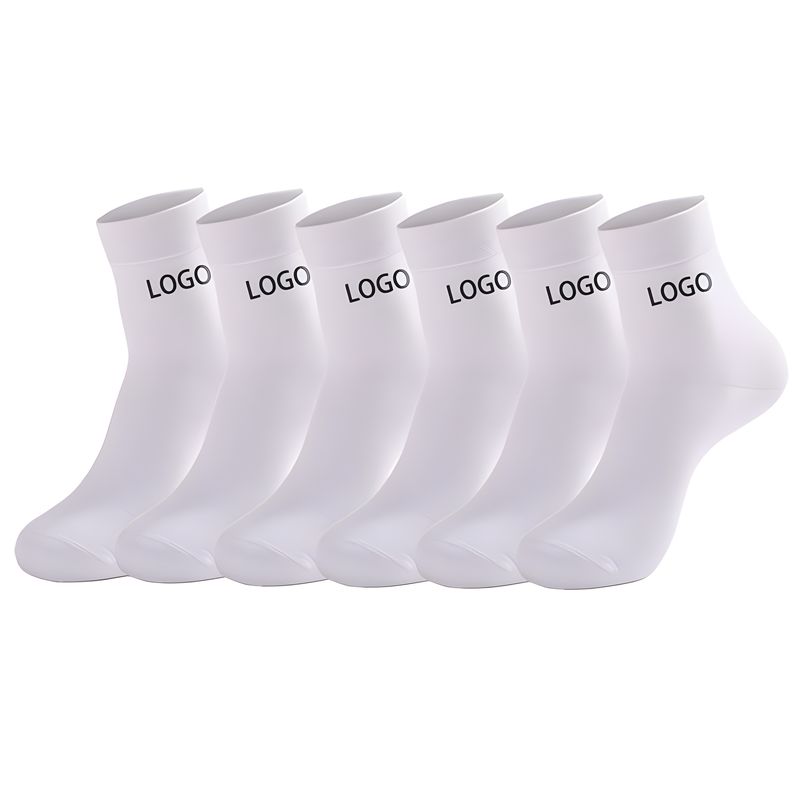
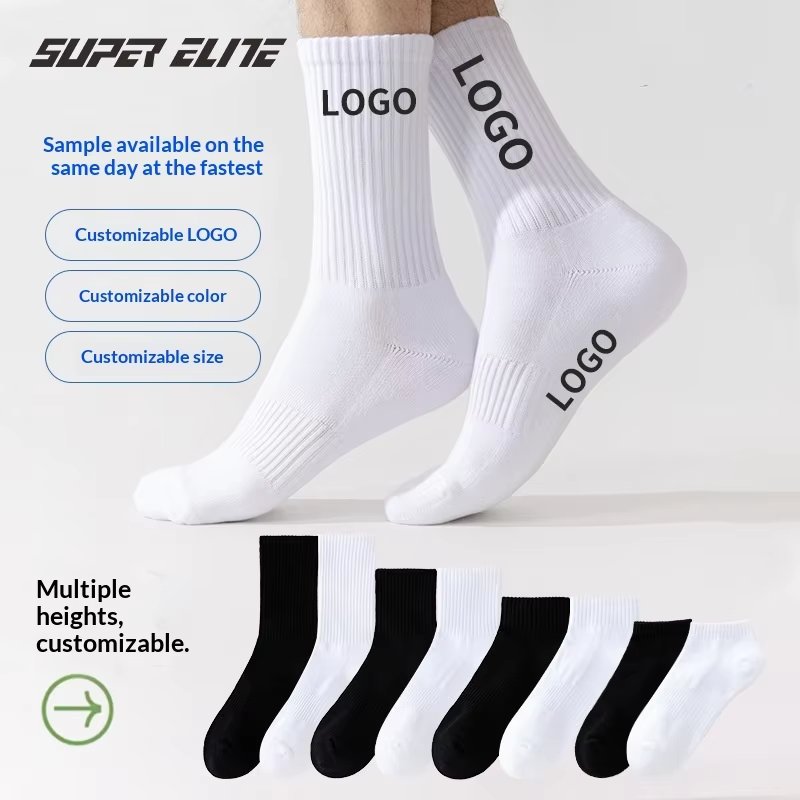
A rib cuff mark is knitted on the same machine that makes the sock, so it becomes part of the garment rather than a layer sitting on top of it. It is also the tightest space on the sock: a cuff knits at a fixed stitch count, fine detail drops out and block shapes survive, which is why a wordmark holds there and a detailed crest does not.
Where it applies: Club and brand cuff marks, retail basics with a discreet mark.
You decide: The mark size, and how much of the detail survives at that size.
Evidence: a logo band knitted into the cuff — see the specification sheet for that style.
The body takes a wider mark, and pays for it in colour
The leg and the foot are where a mark that has to read from across a room goes on, and it goes on as jacquard, knitted into the fabric of the sock rather than printed over it. Colour count is the line that moves the price, and a body holds more colours than a cuff does, so the same artwork can be a cheap mark or an expensive one depending on where it is put.
Where it applies: Brand patterns, lettering up the leg, colour-blocked styles.
You decide: The colour count, and where the mark starts and stops.
Evidence: jacquard recorded as the pattern on a style sheet — see the specification sheet for that style.
The sole carries grip and mark in one operation
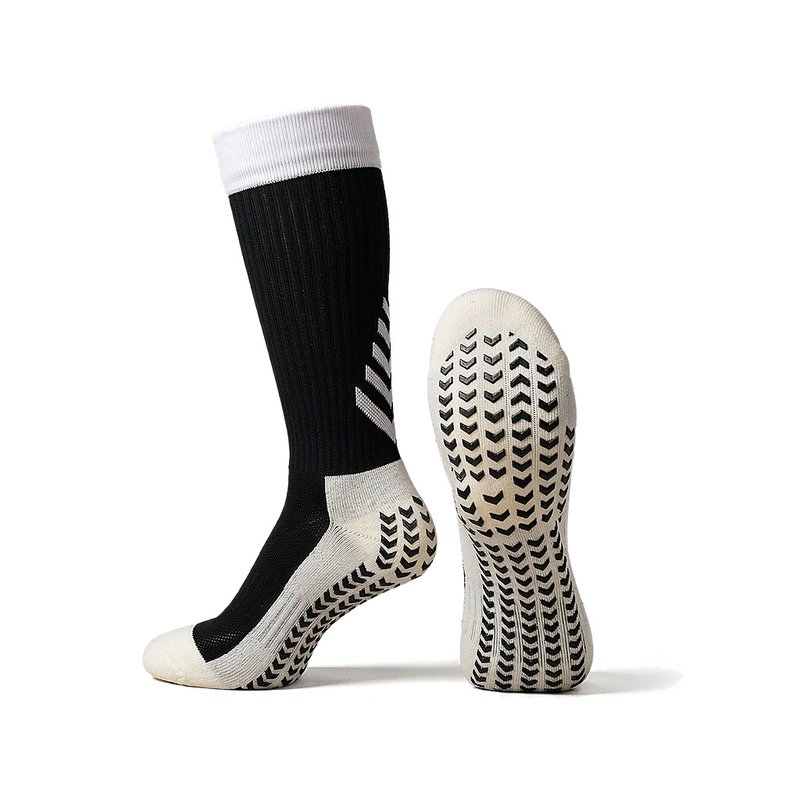
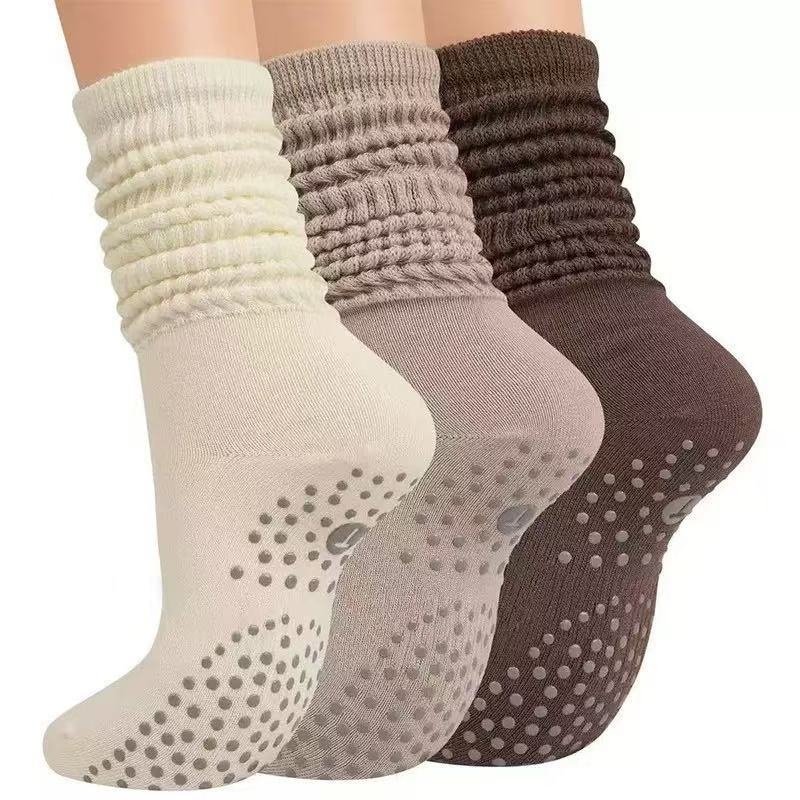
Silicone on the sole does two jobs at once: it is the grip and it is the mark. A silicone print sits on the surface of the knit and wears at its edges, where a knitted grip is part of the sole structure and lasts longer, so the route is chosen for how the sock will be used before the artwork is drawn for it.
Where it applies: Indoor court socks, pilates and yoga, slipper socks.
You decide: Whether the sole carries a silicone print, a knitted grip, or both.
Evidence: a silicone dot sole on a current style — see the specification sheet for that style.
What the site publishes about a mark, and what your artwork settles
A logo buyer should be able to tell which lines are fixed before an email is sent and which ones only exist once the artwork is in the desk's hands. This table keeps those apart.
Terms for a logo run. Published lines are printed on this site; quoted lines are settled on your proforma invoice against the artwork, the position and the approved sample.
- Order size
- 1,000 pairs per style
- Sample
- 3–5 days
- Bulk lead time
- 20–30 days
- Size range
- XS–XXL on request
| Term | What we publish | How your own order sets it | Where it is published |
|---|---|---|---|
| PublishedOrder size | 1,000 pairs per style for bulk orders. | Counted per style and per colourway, so a second colourway with the same mark is a second run. | Quote page, terms page and every style page. |
| QuotedPlacement | Cuff placement is what our own sheets specify; the body and the sole are kept available for a second mark. | Which of the three positions carries the mark, and whether a second mark is added elsewhere. | Placement field on the specification sheet. |
| QuotedMark size | Size is not a published figure; it is set from your artwork against the position you choose. | The width the mark may take where it sits, and the detail that survives at that width. | Artwork and placement fields on the sheet. |
| QuotedColour count | Colour count per design is a quoted line; a cuff holds fewer colours than a full jacquard body. | The colours in the mark itself, and therefore what the run costs per pair. | Specification sheet and quote page. |
| QuotedRoute | Knitted in, embroidered on or printed in silicone; the route is chosen per mark and per position. | Which route lands on which position, and which one the sample has to prove. | Construction field on the specification sheet. |
| PublishedArtwork file | A vector file with the placement named is what the desk works from. | The file you send, and whether it survives the stitch count of the position you chose. | Design process page and quote page. |
| PublishedSample | Typically 3–5 days after the brief and artwork are confirmed; charged per style, credited against the first bulk order. | The first time the mark is seen on a real sock instead of on a screen. | Sample policy page and quote page. |
| QuotedCosting | No price list is printed on this site. | The binding price sits on the proforma invoice against the position, the route and the colour count. | Terms page and quote page. |
The two rows worth pushing on before a logo run are mark size and colour count. Both are answered from the artwork, both are invisible on a screen, and both are the lines that decide whether the mark you approved as a file is the mark that arrives on a sock.
What holds once the mark has been approved on a sample
The sample is where a logo stops being a file. Everything after it is a repeat against the same mark, on the same position, in the same colour, which is what makes a second run arrive looking like the first.
The sample approves the mark, not the screen
Artwork is seen twice: once as a file, once on a sock, and the sock is the one that counts. Two rounds of artwork changes are ordinary, and a third usually means the brief moved rather than the drawing needing work, because what looked right at file size rarely survives a fixed stitch count unchanged.
Where it applies: Marks with thin strokes, small type, multi-colour crests.
You decide: When the mark is right on paper, and then right on the sock.
Evidence: the stages published for this desk — see the design process page.
A repeat runs the same mark, not a redrawn one
The artwork stays on your order file and the approved sample is filed against the order number, so a reorder is knitted against those two references instead of a fresh brief. Colour is bought to a dye lot locked per order, which is what keeps the second run the same colour as the first on a mark where a shade shift would show.
Where it applies: Annual programmes, club kit repeats, reordered best sellers.
You decide: Whether the repeat keeps the mark exactly as approved or moves with your next range.
Evidence: reorder timing on this site — see the reorder lead time page.
The mark on the sock and the mark on the pack are separate decisions
A logo run usually wants the same mark on a header card, a printed box or a size label, and those are packing lines rather than knitting lines. Confirming them together is what stops a shipment arriving with the right sock in a plain bag, which is a mistake that shows on a shelf rather than in a photo.
Where it applies: Retail-ready packs, gifting, marketplace listings that shoot the pack.
You decide: Which elements carry the mark: the sock, the label, the header card, the box.
Evidence: the packing options published here — see the packaging page.
Two styles that went out carrying somebody's mark
Both are current listings on this floor and both were made with a customer's logo on them. Each card opens the style's own page, where the construction and the mark are recorded.
What a logo buyer should not assume
The limits on a mark are cheap to publish and expensive to discover after the sample has been signed.
- No screen colour. The mark is matched to a physical reference you send, then locked to a dye lot per order.
- No price list. The position, the route and the colour count decide the price, and that lands on the proforma invoice.
- No OEKO-TEX or GRS file under our name. If your market requires one, name it in the brief and the reply says what can and cannot be supplied.
- No fine detail at cuff size. A rib cuff knits at a fixed stitch count, so hairlines, small type and gradients drop out of the mark.
- No placement moved after the sample. Where the mark sits is confirmed in writing and is not shifted on the floor once the sample is signed.
- No medical-device claim. The compression line here is a sock knitted to a 20–30 mmHg band, not a registered medical device.
How small the mark can go, knitted or embroidered, and whether the sole will take it
How small can the mark go before it stops reading?
It depends on the position rather than on the file. A rib cuff knits at a fixed stitch count, so block shapes hold and fine detail drops out; the body takes a wider mark and more colours; the sole carries silicone instead of stitches. The desk answers with a width once it holds both the artwork and the position you want it in.
Knitted or embroidered, which should I choose?
A knitted mark is made by the machine that makes the sock and is the cheaper route at volume, while embroidery is a separate operation with its own cost line that holds more detail. A cuff wordmark is usually knitted, a crest on a heavier winter sock is often embroidered, and the route is named on the specification sheet before it is ever quoted.
Can the logo go on the sole without losing the grip?
Yes, on the routes built for it: silicone grips and marks in one operation, and a knitted grip structure can carry the pattern as part of the sole. The two wear differently, since a print sitting on the surface wears at its edges while a knitted structure wears with the sock, so the use the sock is sold for decides which one is quoted.
Send the artwork, the position, and the way the sock will be used
Attach the mark as a vector file, name the position it should take, and say whether the sock is for the street, the court or a warm floor indoors. The reply comes back within one working day with the route proposed for that position, what survives at the size you asked for, the colour count question the run turns on, and the sample timing behind it.
Michelle Zhang, Export sales manager, answers enquiries within one working day — sales@sockwholesalers.com, +86-13761030160 (WhatsApp same number).