 Sock Wholesalers
Sock MOQ and sampling: the 1,000-pair floor, and what happens between brief and bulk
Two numbers sit in front of every first order: how few pairs you can start with, and how long it takes to hold one of them in your hand. This page puts the two together, because they are one decision — the sample is the thing the bulk floor is measured against, and the fee for it comes back off the bulk invoice.
The floor: 1,000 pairs per style
The minimum is per style, not per order. One style can split across sizes — the count that matters is pairs per style, not pairs per size. A first run across three styles therefore carries the minimum on each of the three, and that is the number to plan cash against.
| Band | What it holds | What the desk does with it |
|---|---|---|
| Under 1,000 pairs | Below the bulk floor | Settled per enquiry against the construction; where a run below the minimum is not workable, the sample route is the standing alternative |
| 1,000–4,999 pairs | The bulk floor itself | Costed as a bulk run, against the construction and the colour count |
| 5,000–19,999 pairs | One style, one dye lot | Costed again for this band: the step is not a flat discount, because yarn, needle count, colour count and packing move with the quantity |
| 20,000+ pairs | A style run at production scale | Costed for its own band, and quoted against the line the order books on |
No price ladder is published anywhere on this site, and no percentage off for volume is published either. The unit price that matters is the one costed for your own quantity, artwork and specification, and it arrives with your quotation. The same style sent in under two different bands comes back as two different ranges — and those two replies are the comparison worth making.
Three things the minimum is not
Not a per-order count
It runs per style
A distributor brief carrying five styles is five production runs and five minimums, not one. That is also why a mixed container is planned style by style: each style books its own yarn lot and its own slot on a line.
A multi-style brief is written out on importer and distributor supply.
Not a size count
Sizes split freely inside one style
1,000 pairs in one style can be spread across the size range you sell, in the split you name. The size chart you sell against is the chart the floor knits to, so the split goes in with the brief rather than after the costing.
The fields a size chart has to state are on sock size charts for importers.
Not a wall
Below it, the sample route stands
Whether a lower quantity is workable depends on the construction, and it is settled per enquiry. Where a run below the minimum is not workable, a charged physical sample per style is the standing alternative — you end up holding the product even though no bulk run was booked.
Fees for that route are on sample policy.
What happens between the brief and the bulk run
Six stages, in the order they happen. The clock starts at the point named in each row, not at first contact: artwork that is still moving means the sample has not started yet.
| Stage | The clock starts when | How long | What you hold at the end |
|---|---|---|---|
| 1 Brief and artwork | You send the style, the quantity you are planning and the artwork | One working day to a reply | The sampling fee quoted for your own style, and the next step |
| 2 Sample knitted | You confirm the brief and the artwork | Typically 3–5 days | A physical sample on the needle count quoted |
| 3 Approval | The sample arrives with you | Yours to take | A sample you have signed, not a photo you have liked |
| 4 Deposit | You place the bulk order | Per the proforma invoice | A signed copy on file against your order number |
| 5 Bulk knit | The deposit is received and the sample approved | Typically 20–30 days | Packed cartons, checked against the signed sample |
| 6 Transit | The load is collected | Set by the mode | The tracking reference, against the same order number |
The fee for stage 2 is credited against your first bulk order, so the sample is a step inside an order rather than a product sold on its own. Courier freight for the sample sits with the buyer, on the buyer’s account or booked against it. Both are set out line by line on sample policy, and the fee itself is quoted per style with your quotation rather than published here — the amount follows the construction, exactly as the bulk costing on the same style does.
When a second sample round is the honest answer
One charged sample per style is the normal route. Three things make a second round the right call rather than a delay, and each one is cheaper to find out before the bulk deposit.
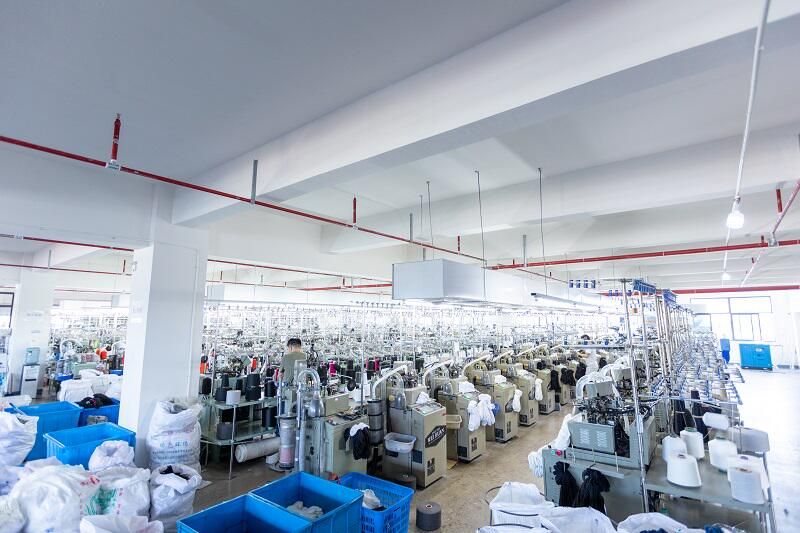
The machines and the toe linking sit on the same floor, so a construction change shows up on a sample within days rather than across a building.
A fibre the floor does not already run
A fibre already running here needs no extra round. A fibre that no current style runs in adds one, because the construction has to be knitted and signed before bulk. Merino is the standing example: it is named on this site as a yarn we quote, and a merino brief adds a round rather than slotting into an existing setting.
A colourway change
A straight repeat of a locked specification is not a new sample. A colourway change is one, because colour is matched on yarn rather than on a screen, and the sample you sign is what bulk is checked against.
A design that moved after approval
Bulk runs to the sample you approved, and the signed copy is the binding reference the run is judged against. Artwork that changes after approval is a new sample; it is not a note on the bulk order.
A second round is a new charge, at the same per-style basis as the first.
What to send, so the first reply is a costing
The brief is short either way. What changes is which half of it you fill in: an OEM brief leads with the specification, an ODM brief leads with the market and the changes you want on a base that already runs.
OEM brief
You bring the design
- The construction: needle count, cushioning zones, mesh placement
- The yarn composition, with the percentages in numbers
- The size range and the split you sell
- Colours with physical references where the shade matters
- Packaging and the artwork placement
A physical reference sock answers most of the questions a written specification would. OEM vs ODM socks sets out both routes.
ODM brief
You change a base that already runs
- The market and the channel you sell into
- Your brand and where it appears: knit, label or packaging
- The changes you want on the base — colour, rib cuff, grip layout
- The quantity band you can carry
- The artwork, if a logo or a lettering set is part of it
On a grip sock the three changes that move how it sells are the grip-dot layout, the rib cuff height and the cuff elasticity; all three are settled before sampling starts.
Questions buyers ask about MOQ and samples
Is the fee credited against the bulk order?
Yes. The sampling fee comes back off your first bulk order, so a buyer who goes on to run bulk pays for the sample once. A buyer who stops after the sample has paid for the sample — that is the trade, and it is why the fee is quoted per style rather than published as a catalogue figure.
Can I approve from photographs?
Approval is a physical sample, not a photograph. Colour is matched on yarn rather than on a screen, and the signed copy stays on file against your order number as the reference the bulk run is checked against. Photographs are how the round is discussed; they are not what is signed.
Do sizes count against the minimum separately?
No. Sizes split inside one style: 1,000 pairs in a style can be spread across the size range in the split you name. The minimum is per style, so a three-size first run is still one run.
What if my quantity lands nowhere near a band?
Write the figure you actually plan rather than rounding it into a band. A range is costed for the band you name and the bands are boundaries rather than price lists; a run below the floor is settled per enquiry, and the sample route stands if the construction does not support it.
Does a reorder need a new sample?
Not for a straight repeat. The first production run fixes the construction, the yarn, the colour and the sample on file, and a reorder runs on that same specification. A colourway change is a new sample; anything that moves the knitted structure is a new sample as well.
Who owns the design I bring?
On an OEM build you bring it and the factory knits exactly that. On an ODM base the underlying design is the factory’s, so exclusivity, if you need it, is agreed in writing rather than assumed. Both questions are cheaper to ask before sampling than after bulk.
Where the rest of the terms sit
Send the style and the quantity band
The fastest brief names the style, the quantity you are planning and the artwork you already hold. The desk costs it within one working day and the reply carries the sampling fee for your own construction, not a catalogue number.
Start the brief